

For many aspiring artists, a career in the visual arts is a calling – something you absolutely know that you were meant to do. Art may be your destiny, but what are the practical steps to making a viable career of it? If you’re wondering how to become an artist, this guide will give you an honest breakdown of what it takes to break into the industry, build your career, and sustain it.
We’ll walk you through everything from developing your practice at school, to choosing the right further education, and navigating the professional art world beyond graduation.
We also discuss Dukes Plus’s own Young Art & Design Summer Experience, an incredible art summer school in London that immerses students aged 15-18 into life as an artist or designer.
What Does a Visual Artist Actually Do?
Before we get into how to become an artist, it is worth being honest about what the career involves, because it rarely looks like the romanticised version.
Visual artists create original works using media such as painting, drawing, printmaking, sculpture, installation, photography or mixed media. Some work primarily as fine artists, developing a body of work to exhibit in galleries and sell to collectors. Others follow a more commercial path – working as illustrators, concept artists, muralists, animators, creative technologists or art directors. Many do both, maintaining a personal practice alongside freelance or employed creative work.
The reality is that most professional artists combine multiple income streams. These might include selling original works, licensing images, taking private commissions, applying for grants and residencies, teaching, running workshops, or working in adjacent creative industries. Successful artists tend to treat their practice as a business as much as a vocation – and those who build financial stability early in their careers are usually the ones who planned for that from the start.
Starting Early: What to Do at School
The habits you build now will shape the kind of artist you become. Technical skill matters, of course, but your school years are also about developing the discipline, curiosity, and visual intelligence that drive a long creative career.
Make Art Every Day
The single most important thing you can do at this stage is practise consistently. Keep a sketchbook. Use it daily. Experiment with different media, whether that’s pencil, ink, paint, collage, or digital tools. Art schools and universities want to see evidence of a restless, exploratory, enquiring mind. That said, developing one or two particular specialisms is a good idea. Building an area of high skill will enable you to produce better, more interesting work.
Document everything. Photograph your work in progress, keep your process notes, hold onto studies and experiments even when they feel unsuccessful. Art school applications typically require not just finished pieces but evidence of how you think and develop ideas – your sketchbooks are often as important as your final work.
Take Art Seriously at School
If your school offers Art and Design as a subject, take it at GCSE and A Level or IB. Beyond that, subjects like Art History, Photography and Design are all directly relevant. However, there is no single perfect combination of subjects. Courses that develop critical thinking, visual analysis, communication and cultural awareness – including History, English Literature, Philosophy, Computer Science and the sciences – can all influence your artistic practice. Many great artists have drawn on interests far beyond the traditional art classroom.
Look for opportunities to draw from observation, whether through school, a local art society, a community studio or independent practice. Life drawing can be particularly valuable because it develops your understanding of proportion, movement, structure and form. However, it is not the only way to demonstrate observational skill. Depending on your interests, you might draw people in public spaces, buildings, natural forms, objects or environments. Always check the portfolio guidance for each course, as expectations vary between fine art, illustration, animation, photography, fashion and other disciplines.
Visit Galleries and Study Art Seriously
Immerse yourself in art beyond the classroom. Visit galleries, museums and exhibitions as often as you can. Don’t just look – read, research and think critically. Understand art history: who were the major movements and why did they matter? Who are the significant contemporary artists working today and what are they responding to?
The ability to contextualise your work within a broader artistic conversation – to explain your influences and understand how your practice relates to what has come before – is something that art schools and, later, the professional art world both expect. It is also what separates artists who develop a distinctive voice from those who never quite find one.
You don’t want to slavishly copy the artists you admire. But if you don’t understand where you’ve come from, it’s much harder to know where you want to go.
You can also consider doing art work experience in a gallery, auction house, or design agency for more professional experience of the art world.
Build Your Portfolio from Now
Your portfolio is the most important thing you will produce as a student. It is the primary basis on which art schools assess your application, and it will continue to define your professional identity long after you graduate.
A strong portfolio shows how you think as much as what you can make. Art schools want to see evidence of experimentation, research, development and a personal point of view. Depending on the course, they may also want observational work, technical studies, moving image, sketchbook pages or documentation of three-dimensional pieces. Quality matters more than quantity, but do not assume that every institution wants the same number of pieces. Portfolio requirements can differ considerably, including limits on images, video length and file size. Read each course’s instructions carefully and edit your submission for that particular programme rather than sending an identical portfolio everywhere.
Seek feedback actively and widely. Show your work to your art teacher, to working artists if you can access them, and to peers whose judgement you trust. Different people will give you different feedback. That is to be expected and shouldn’t throw you: learning to weigh and respond to critique is itself a core artistic skill.
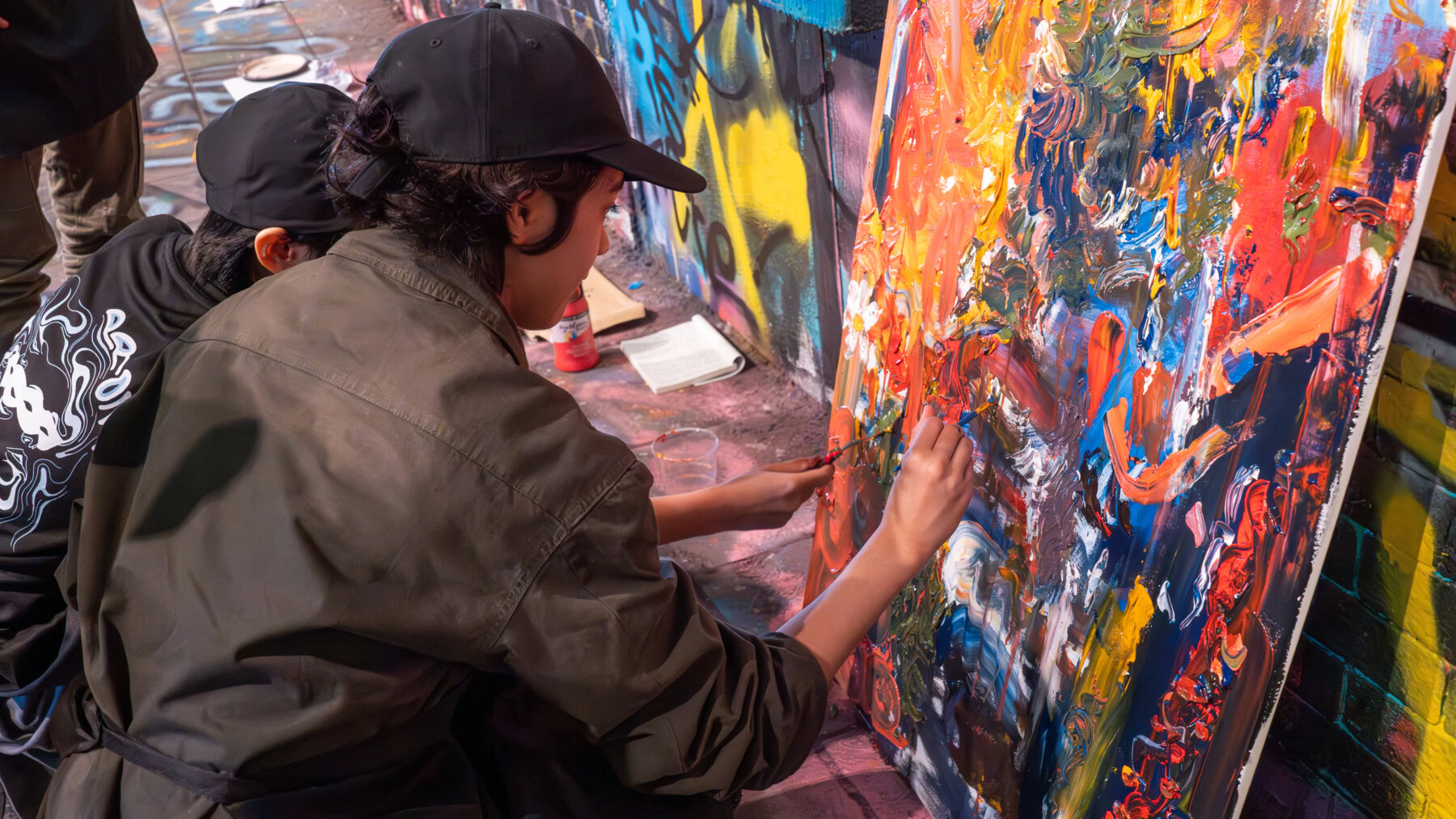
Young Art & Design Summer Experience
Immerse yourself in the career of an artist or designer on our incredible summer programme. Hone your skills with a variety of artistic masterclasses and exhibit your work in a real London gallery.
Further Education: Art School
This is the most significant decision you will face as a young aspiring artist, and it is worth taking seriously.
Do You Need to Go to Art School to Become an Artist?
Unlike some professions, a degree is not required to become a visual artist. The art world ultimately judges you on the quality of your work, your exhibition history and the strength of your professional network. Some highly successful artists are self-taught.
That said, a good art education offers things that are very hard to replicate alone: structured critical dialogue with tutors and peers, access to professional-grade facilities, time and space to experiment and fail, and – crucially – the beginnings of a professional network. For most students, further education is genuinely worth it. The question is which kind.
Undergraduate Degrees
A Bachelor of Fine Arts (BFA) or equivalent undergraduate degree typically lasts three to four years and offers structured studio practice alongside critical theory, art history, and professional development. When choosing a course, consider the specialisms on offer, the quality of studio facilities, the strength of the visiting artist and lecture programmes, and – perhaps most importantly – the calibre of the graduate shows produced by current students.
Among the most highly regarded art institutions in the world are the Royal College of Art and University of the Arts London in the UK; Rhode Island School of Design (RISD) and Yale School of Art in the US; and Parsons School of Design in New York and Paris. According to the QS World University Rankings, the Royal College of Art has held the top position globally for art and design for several consecutive years.
However, many, many excellent artists have trained at less famous institutions – what matters is the quality of teaching, the creative culture, and what you make of the opportunities available to you.
Postgraduate Study
Many artists go on to complete a Master of Fine Arts (MFA) after working professionally for a few years. An MFA can deepen your practice, raise your critical profile and open doors to teaching in higher education. It is typically more valuable after you have gained some professional experience in the art world than immediately after your undergraduate degree.
Free Webinar
Watch the recording of our webinar ‘Breaking into the Creative Arts’ with a professional illustrator and designer for tips on taking your first steps into a creative career.
Building a Professional Practice After Art School
Graduating from art school is, of course, just the beginning. The transition from student to professional artist is one of the most challenging periods in any creative career, and those who navigate it best are usually those who have started thinking about it before they leave.
Your Portfolio and Online Presence
A professional website is one of the most useful things you can build, although it does not need to be complicated or expensive. It should be clean, easy to navigate and focused on your strongest work, with clear titles, dates, dimensions and media. Include a short biography, an artist statement, your exhibition history and a professional contact address. Think of it as a permanent, evolving exhibition of who you are as an artist. Social media – particularly platforms that are visually oriented, like Instagram – can also be a powerful tool for building an audience, attracting commissions and connecting with the wider art community.
Exhibitions and Getting Seen
The art world runs on exhibitions. Showing your work – even in small, local spaces – builds your exhibition record, gets your work in front of collectors and curators, and develops the professional confidence that comes from seeing how an audience responds to what you make.
Start by applying to open calls for group exhibitions and graduate shows. As your profile grows, you can begin approaching galleries more formally. Commercial galleries typically take a commission of 40–50 per cent on sales; this may seem steep, but a good gallery relationship brings promotion, access to collectors, and professional credibility that is very hard to generate independently, especially if you’re a relatively inexperienced recent grad.
Income Streams and Financial Sustainability
Here’s where things get serious. If you’ve told people that you want to become an artist, you’ve likely heard them reply, ‘but how will you make any money?’.
It can sound cynical to confront the financial realities of an art career, but it’s actually essential. Most artists, particularly in the early years, combine their practice with other work. Common strategies include:
- teaching art privately or in schools
- taking on illustration, mural or other commercial commissions
- selling prints and editions alongside original works
- licensing images
- applying for grants and artist residencies
- developing a strong online shop
Many people, of course, work on their art in evenings and at weekends while working a separate, full-time job. This is usually more secure and, as long as you are able to dedicate a good amount of time to your art, then needn’t prevent you becoming a professional artist in the long-term.
The artists who sustain long careers tend to be those who have diversified their income intelligently, treated their practice as a business, lived within their means and – above all – kept making work regardless of whether it was immediately selling.
Artist Residencies and Grants
Residencies are one of the art world’s most valuable and underused opportunities, especially for emerging artists. They provide time, space, facilities and – perhaps most importantly – a professional network that often includes other artists, curators, collectors, and gallery directors. Winning a residency is a meaningful entry on your professional CV and a signal to the wider art world that your practice is serious.
Grants from arts councils, foundations and cultural institutions are another important income source, and one worth researching thoroughly for your country. Applying for grants requires effort and persistence, but success both provides financial support and builds your credibility and public profile.
Skills Needed to Become an Artist
There are as many paths into the art world as there are artists. But underpinning almost all successful art careers are the following skills:
- Technical skill – a deep command of at least one medium, combined with genuine curiosity about others. Technique is the instrument through which your ideas become real.
- Visual intelligence – the ability to look hard, think carefully about what you see, and make deliberate choices about composition, colour, scale and form.
- Critical self-awareness – the capacity to evaluate your own work honestly, to understand its strengths and weaknesses, and to keep developing rather than repeating yourself.
- Resilience – a career in the arts involves rejection, periods of creative doubt and financial uncertainty. The artists who last are those who find ways to keep working through all of it.
- Professional self-management – running a studio, managing commissions, applying for opportunities, keeping records, understanding contracts and copyright. The business side of art is unglamorous but unavoidable.
Your Visual Arts Career: A Timeline Summary
This checklist condenses our advice on how to become an artist, with some key actions to take at every stage of your development.
| Stage | Key Actions |
| Ages 15–16 | Keep a daily sketchbook; experiment with media; visit galleries; begin building a portfolio |
| Ages 16–18 | Study art formally; take life drawing; develop portfolio seriously; seek critique and feedback |
| Undergraduate degree | Develop studio practice; build professional network; start exhibiting; apply for residencies |
| Post-graduation | Establish professional presence; pursue exhibitions, grants and residencies; develop multiple income streams |
The Young Art & Design Summer Experience
If you’re looking to become an artist, Dukes Plus’s Young Art & Design Summer Experience is an incredible summer school in London for ages 15-18.
Over two inspiring weeks, you’ll immerse yourself in the life of an artist in one of the world’s most creative cities and experience the vibrant art scene of London firsthand:
- Sketch the iconic skyline from the top of The Tate Modern
- Hone your skills with a variety of artistic masterclasses
- Showcase your work in a real London gallery
Learn more about The Young Art & Design Summer Experience or book your place today.
FAQs
No – a formal degree is not required to become a visual artist. Your career will ultimately depend on the strength of your portfolio, exhibition history, and professional network. However, art school can provide expert teaching and feedback, access to facilities, and valuable connections that are difficult to build independently. Many students find that art school accelerates both their artistic and professional development.
If you’re exploring how to become an artist without going to art school, you’ll need to be highly self-directed. Focus on building a strong, cohesive portfolio, practising consistently, and proactively building a community of other artists to learn from and network with. Attend exhibitions, apply for open calls, and develop an online presence to showcase your work. Many successful artists are self-taught – the key is to treat your development with as much rigour and discipline as if you were studying at a formal art school.
Art and Design is the most obvious choice at GCSE and A Level or IB, but subjects like Photography, Art History and Design are also highly relevant. Beyond that, essay-based subjects such as English Literature or History can help develop your critical thinking, cultural awareness, and aesthetic sensibility.
There is no fixed timeline. Some artists begin exhibiting or selling work while still studying, while others take years to establish themselves. Typically, you might spend 3–4 years in undergraduate study, followed by several years building your practice, portfolio and exhibition record.
Yes, but it rarely comes from a single income source, especially early on. Most artists combine multiple revenue streams such as selling original works, commissions, teaching, grants, residencies, or commercial projects like illustration. Financial stability usually comes careful planning and diversifying your income, rather than hoping for a few massive gallery sales.
Technical ability is, of course, the foundation of any successful artistic career. While it’s advisable to explore a range of media in your early development, most artists specialise in just one or two disciplines as they mature, allowing them to develop high levels of technical mastery.
That said, technique is only one part of the picture. You also need visual sensitivity, critical thinking, imagination, and the ability to evaluate and improve your own work. Just as crucial are resilience and professional discipline – managing your time, promoting your work, and bouncing back from rejection are all central to sustaining a long-term career in the arts.