

British architecture spans over a thousand years of history, from the soaring spires of medieval cathedrals to the gleaming steel-and-glass towers reshaping our city skylines today. The famous British architects who influenced that history include some of the world’s greatest architectural visionaries. They changed the way we think about space, structure, and beauty.
In this guide, we count down ten of the best-known British architects of all time, exploring their lives, their ideas, and the buildings that made them legends. From neoclassical elegance to startling postmodernism, each one has left a mark on the built environment of the UK and the world.
10. George Gilbert Scott (1811–1878)
Biography
Sir George Gilbert Scott was the defining architect of the Victorian Gothic Revival, a movement that sought to bring the drama and spirituality of medieval architecture back to industrial Britain. Born in Gawcott, Buckinghamshire, Scott trained under architect James Edmeston before establishing his own prolific practice. Deeply religious and tireless in his work ethic, he completed an extraordinary number of projects across Britain – churches, country houses, public buildings, and universities.
He is particularly associated with the restoration of medieval cathedrals, though his methods were sometimes criticised for being too interventionist. Despite occasional controversy, Scott’s talent for grand, expressive design was undeniable, and his output helped define what Victorian Britain looked like in stone.
Notable buildings / achievements
- St Pancras Station and the Midland Grand Hotel, London (1868–1876)
- The Albert Memorial, Kensington Gardens, London (1872)
- Glasgow University Main Building (1870)
- Restoration work on Ely, Salisbury, and Lichfield Cathedrals
9. Nicholas Hawksmoor (1661–1736)
Biography
Next on our list of famous British architects, Nicholas Hawksmoor is one of the most mysterious and original figures in English architectural history. Born in Nottinghamshire, he began his career as a clerk to Christopher Wren at the age of eighteen, eventually becoming his most trusted assistant. He also worked closely with John Vanbrugh on Blenheim Palace and Castle Howard.
Yet Hawksmoor was more than a sidekick. His own independent commissions reveal a deeply personal style that blended the Baroque with ancient classical forms in ways that felt almost otherworldly. He spent decades designing six new London churches under the Commission for Building Fifty New Churches Act (1711), and those buildings remain among the most atmospheric in the city. Hawksmoor never received the public recognition his genius deserved during his lifetime, but his reputation has grown enormously in the centuries since.
Notable buildings / achievements
- Christ Church Spitalfields, London (1729)
- St George’s, Bloomsbury, London (1731)
- Clarendon Building, Oxford (1715) (also featured on our list of Oxford’s most famous buildings)
- West towers of Westminster Abbey (completed posthumously, 1745)
- Contributor to Blenheim Palace and Castle Howard

License: Wikimedia Creative Commons
8. Charles Barry (1795–1860)
Biography
Sir Charles Barry is best known for one of the most photographed buildings on earth: the Palace of Westminster. Born in Westminster himself, Barry trained as an architect and spent his early career travelling extensively through Europe and the Middle East, absorbing a wide range of architectural influences. On his return to Britain, he developed a reputation for refined, scholarly work in both the Italianate and Gothic Revival styles.
After the Houses of Parliament were destroyed in a fire in 1834, an open architectural competition was held to determine its new design. Barry’s winning entry cemented his place in history. The project was a massive collaboration, notably with Augustus Pugin, who designed the richly detailed Gothic interiors and decorative scheme. Barry managed the vast undertaking for the rest of his life, and the building was still not fully complete when he died.
Notable buildings / achievements
- Palace of Westminster (Houses of Parliament), London (1840–1870, with A.W.N. Pugin)
- Reform Club, Pall Mall, London (1841)
- Bridgewater House, London (1851)
- Halifax Town Hall (1863, completed by his son)
7. Inigo Jones (1573–1652)
Biography
Inigo Jones was nothing less than a revolutionary – the architect who introduced Renaissance classicism to England and changed the course of British architecture forever. Born in Smithfield, London, Jones travelled to Italy where he immersed himself in the work of ancient Rome and the Renaissance master Andrea Palladio.
When he returned to England, he brought those ideas with him, applying them to royal commissions under James I and Charles I. In a country still dominated by Jacobean extravagance and medieval tradition, his clean, rational, symmetrical designs were startlingly modern. He also worked as a theatrical designer for the court masques of Ben Jonson, demonstrating a rare combination of architectural and artistic talent. His influence on the following two centuries of British architecture, including the Palladian revival of the 1700s, cannot be overstated, meaning he easily merits his place on our list of the most famous British architects.
Notable buildings / achievements
- The Queen’s House, Greenwich (1635)
- The Banqueting House, Whitehall, London (1622)
- St Paul’s Church, Covent Garden, London (1633)
- Redesign of St Paul’s Cathedral facade (destroyed in the Great Fire)
6. Richard Rogers (1933–2021)
Biography
Lord Richard Rogers was one of the most daring and influential architects of the twentieth century, a man who genuinely changed what buildings were allowed to look like. Born in Florence to a British-Italian family, Rogers studied at the Architectural Association in London and later at Yale, where he met Norman Foster. Together they formed Team 4 before going their separate ways.
Rogers shot to international fame with the Centre Georges Pompidou in Paris (1977), co-designed with Renzo Piano, which turned a building inside out – placing its structural and mechanical elements on the outside so the interior could be open and flexible. Back in Britain, he continued to push boundaries, championing high-tech architecture and consistently arguing that good design could make cities more humane, democratic, and sustainable.
Notable buildings / achievements
- Centre Georges Pompidou, Paris (1977, with Renzo Piano)
- Lloyd’s Building, London (1986)
- Millennium Dome (now The O2), London (1999)
- Terminal 5, Heathrow Airport, London (2008)
- Recipient of the RIBA Gold Medal (1985) and the Pritzker Architecture Prize (2007)
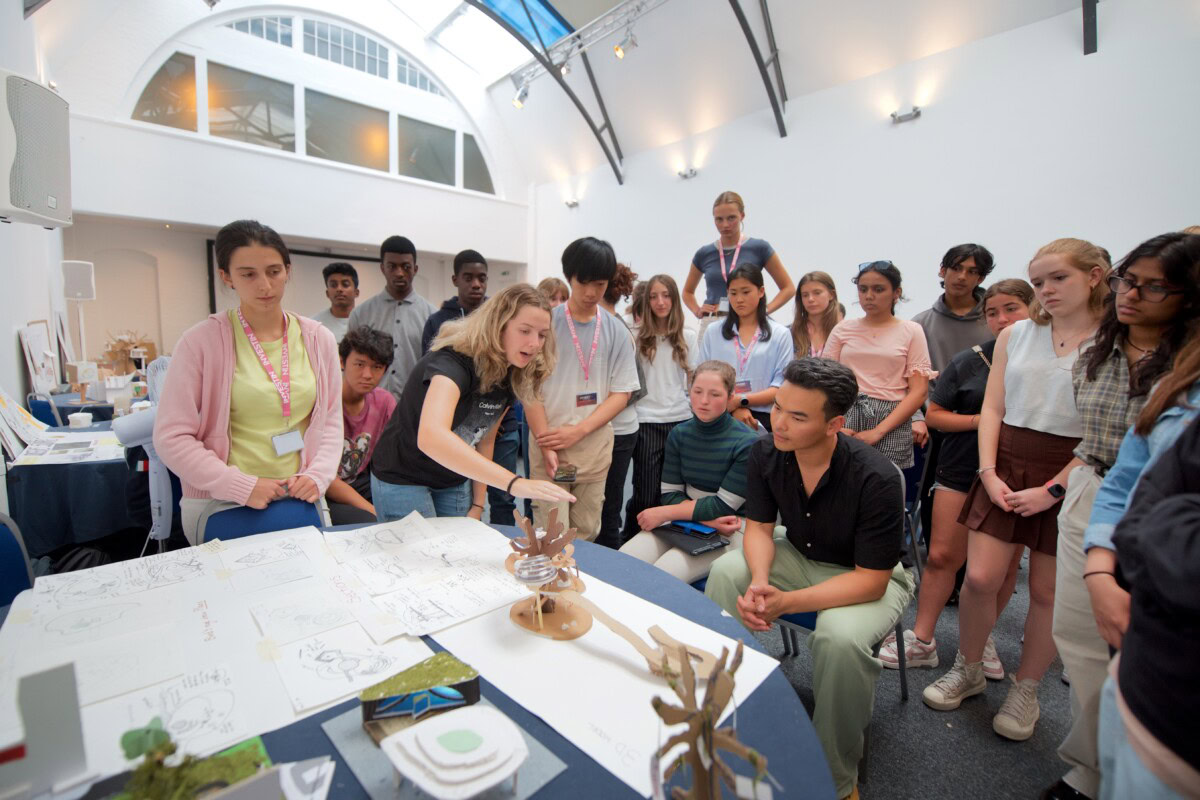
Young Architect Summer Experience
Immerse yourself in the career of an architect on our incredible summer programme. Design your own sustainable structure, get mentoring from professional architects, and receive feedback on your work from industry pros.
5. Edwin Lutyens (1869–1944)
Biography
Sir Edwin Lutyens, known to his friends simply as “Ned”, was the supreme English architect of the late Victorian and Edwardian eras, celebrated for an extraordinary versatility that ranged from cosy Arts and Crafts country houses to monumental imperial planning. Born in London, Lutyens showed exceptional natural talent from an early age and established his reputation designing picturesque country homes in Surrey, often in collaboration with the garden designer Gertrude Jekyll.
His career later expanded dramatically in scale: he was appointed one of the principal architects for New Delhi, designing the Viceroy’s House (now Rashtrapati Bhavan), one of the grandest government buildings of the twentieth century. He is also remembered with deep affection for his restrained, deeply moving war memorials, particularly the Cenotaph in Whitehall.
Notable buildings / achievements
- The Cenotaph, Whitehall, London (1920)
- Viceroy’s House (now Rashtrapati Bhavan), New Delhi (1929)
- Castle Drogo, Devon (1930) – Often described as the last castle to be built in England
- Heathcote, Ilkley, Yorkshire (1906)
- Numerous Arts and Crafts houses across Surrey and the Home Counties
4. Capability Brown (1716–1783)
Biography
Lancelot “Capability” Brown was a landscape architect whose transformation of the English landscape was so total, so influential, and so deeply connected to the country houses he worked alongside, that it would be wrong to leave him out of any list of famous British architects. Born in Northumberland, Brown began his career as a kitchen gardener before rising to become the most sought-after landscape designer in Britain. He earned his nickname from his habit of telling clients their grounds had “great capabilities.”
Working across hundreds of estates, he swept away formal geometric gardens and replaced them with sweeping lawns, serpentine lakes, clumps of trees, and carefully framed vistas – creating a vision of nature that paradoxically looked entirely natural but was entirely artificial. His work defined the English landscape garden, a style that spread across Europe and beyond.
Notable buildings / achievements
- Blenheim Palace gardens, Oxfordshire (1760s)
- Chatsworth House gardens, Derbyshire (1760s)
- Stowe Landscape Garden, Buckinghamshire (1740s–1780s)
- Petworth Park, West Sussex (1750s)
- Over 170 landscape commissions across Britain
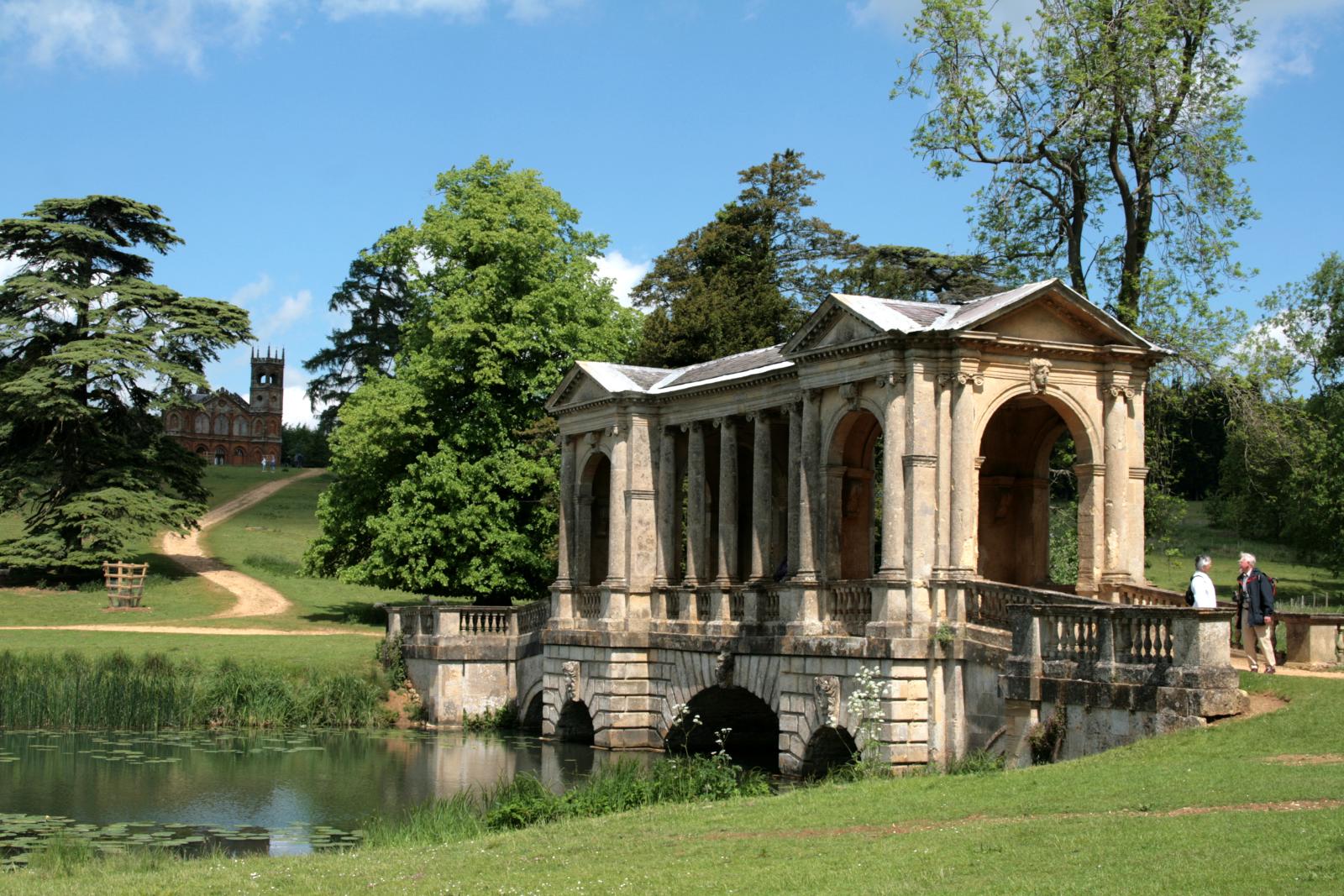
License: Wikimedia Creative Commons
3. Zaha Hadid (1950–2016)
Biography
Dame Zaha Hadid was one of the most original and electrifying architects of the modern age. As a designer who refused to accept that buildings had to be rectangular, static, or predictable, she shook up the architectural world. Born in Baghdad, Iraq, Hadid studied mathematics in Beirut before coming to London’s Architectural Association, where her extraordinary talent quickly set her apart. Having become a British citizen around 1980, she spent years producing visionary projects that were widely praised but rarely built, earning her the unwanted nickname “the paper architect.”
That changed in the 1990s and 2000s, when a series of major commissions proved that her fluid, dynamic, apparently impossible forms could actually be constructed. She was the first woman to win the Pritzker Architecture Prize (2004) and the first to be awarded the RIBA Royal Gold Medal in her own right (2016). She was based in London for most of her career, and the city rightly claims her as its own.
Hadid also features in our list of the most famous women architects in history.
Notable buildings / achievements
- Aquatics Centre, London Olympic Park (2012)
- MAXXI National Museum of 21st Century Arts, Rome (2010)
- Guangzhou Opera House, China (2010)
- Heydar Aliyev Centre, Baku (2012)
- BMW Central Building, Leipzig (2005)
2. Norman Foster (1935–)
Biography
Lord Norman Foster is one of the world’s best-known living British architects – a titan of global architecture whose buildings have reshaped cities on every continent. Born in Reddish, Greater Manchester, Foster grew up in modest circumstances and worked in the Manchester City Treasurer’s office before winning a scholarship to study architecture at Yale. On his return to Britain, he co-founded Team 4 with Richard Rogers, Su Rogers, and Wendy Cheesman, before establishing Foster + Partners, now one of the world’s leading architectural practices.
Foster is the defining figure of high-tech architecture: a style characterised by the expressive use of advanced engineering, lightweight structures, and the integration of natural light. His buildings manage to be simultaneously futuristic and humane, technically brilliant and visually thrilling. He has won virtually every major award in architecture, including the Pritzker Prize in 1999.
Notable buildings / achievements
- The Gherkin (30 St Mary Axe), London (2003)
- The Great Court, British Museum, London (2000)
- Millau Viaduct, France (2004)
- Wembley Stadium, London (2007)
- Hong Kong International Airport (1998)
- Reichstag dome, Berlin (1999)
- RIBA Royal Gold Medal (1983) and Pritzker Architecture Prize (1999)

1. Christopher Wren (1632–1723)
Biography
The most famous British architect in history, Sir Christopher Wren is also arguably the most significant – a man who rebuilt London after the Great Fire of 1666 and left behind a legacy of extraordinary buildings that still define the capital’s skyline. Born in East Knoyle, Wiltshire, Wren was first and foremost a scientist: a professor of astronomy at Oxford who counted among his friends Robert Boyle and Isaac Newton.
Architecture came to him relatively late, but he took to it with spectacular success. When fire tore through London in September 1666, destroying over 13,000 houses and 87 churches, Wren was appointed Surveyor of the King’s Works and charged with rebuilding the city. His masterpiece, St Paul’s Cathedral, took 35 years to complete and remains one of the world’s great domes. He designed over 50 London churches in total.
Notable buildings / achievements
- St Paul’s Cathedral, London (1710)
- The Royal Hospital Chelsea, London (1692)
- The Royal Observatory, Greenwich (1676)
- Trinity College Library, Cambridge (1695)
- Over 50 City of London churches rebuilt after the Great Fire
Conclusion: Famous British Architects
From Inigo Jones sweeping away medieval English architecture with neoclassicism in the seventeenth century to Norman Foster reimagining the modern in the twenty-first, the famous British architects on this list share one essential quality: the courage to do something new. Not content with simply designing buildings, they asked fundamental questions about how people should live, move, and experience the world around them. If you’ve been inspired by these stories, explore our guide on how to become an architect.
Experience a Career as an Architect
If you’re interested in becoming an architect, Dukes Plus’s Young Architect Summer Experience offers an unparalleled immersion into a career in the industry.
During this two-week architecture summer school in London for ages 15-18, you will:
- Visit a leading architecture and urban design firm
- Use industry-standard architectural sketching tools
- Design and create 3D building models using professional modelling techniques
- Create a design from a brief under supervision from real architects
You’ll be taught by experienced architects and receive career coaching on university choices and ways into the industry.
Hosted at the UCL campus in London, you’ll also experience what it’s like to study at one of the world’s top universities.
Learn more about The Young Architect Summer Experience or book your place today.
FAQs
Some of the most well-known British architects include Sir Christopher Wren, Sir Norman Foster, Zaha Hadid, Inigo Jones, and Sir Edwin Lutyens. These figures are widely recognised for shaping British architecture over the centuries.
Many iconic UK landmarks were designed by British architects. For example, Christopher Wren designed St Paul’s Cathedral, Norman Foster created the Gherkin in London, and Charles Barry was responsible for the Palace of Westminster. These buildings are key examples of Britain’s architectural heritage.
Yes – modern famous British architects include Norman Foster and the late Zaha Hadid, both of whom have designed major international projects. Their work is often associated with innovative materials, sustainability, and bold, futuristic forms.
No, many British architects have worked globally. For example, Norman Foster has designed major projects across multiple continents, including Hong Kong International Airport, the Reichstag Dome in Berlin, and Hearst Tower in New York City. Zaha Hadid is known for the MAXXI National Museum of 21st Century Arts in Rome and the Guangzhou Opera House.
This is, of course, a matter of personal judgement and will depend on how you rate an architect’s style and influence. However, the strongest candidate is probably Sir Christopher Wren. After the Great Fire of London, he led the rebuilding of much of the capital, designing over 50 churches as well as his masterpiece, St Paul’s Cathedral. His work helped define London’s skyline and set the direction of British architecture for generations.

Author
Louis Scott , Education Content Writer