


What does it take to be one of the best engineers in the world? From designing bridges that last for centuries to launching rockets to the Moon, engineers use stunning creativity and ironclad logic to shape our future.
If you’re aiming to become an engineer, this article about history’s greatest engineers – both past and present – will inspire you to dream big. These innovators come from different countries and disciplines, proving that engineering excellence knows no boundaries. Each story shows how passion and perseverance can solve problems and change the world.
Read on to discover ten of the best engineers in the world, and see how you could follow in their footsteps.
Leonardo da Vinci – The Renaissance Visionary
Leonardo da Vinci (1452–1519) is often celebrated as a painter, but he was also an extraordinary engineer and inventor. He truly defined the idea of a “Renaissance man” with knowledge spanning art, science, architecture and engineering.
In his notebooks, Leonardo drew designs for flying machines, tanks, bridges, and submarines long before the technology existed to build them. For example, his famous “Aerial Screw” sketch (below) is seen as a precursor to the modern helicopter, 400 years before the first helicopter was produced. These designs and ideas were mostly produced during his time as the military engineer for Ludovico Sforza, who was Duke of Milan from 1494 to 1499. He also engineered civic engineering for Milan, with his pioneering water-management systems still influential in urban planning today.
Known as one of the most prolific inventors in history, Leonardo was never afraid to dream big and imagine the impossible. His visionary engineering ideas – from war machines to underwater diving suits – were centuries ahead of their time, making him a timeless inspiration for young engineers with big imaginations.
Greatest Achievements
- Designed remarkably prescient concepts for flying machines, armoured vehicles, and hydraulic pumps, centuries before the technology to build them existed
- Engineered large-scale canal and water management systems for Milan, including retractable locks still influential in hydraulic engineering
- His anatomical studies directly informed his mechanical designs, treating the human body as an engineering system
Quotation
“Iron rusts from disuse; water loses its purity from stagnation… even so does inaction sap the vigour of the mind.”

Isambard Kingdom Brunel – Mastermind of Modern Infrastructure
Isambard Kingdom Brunel (1806–1859) was a British civil and mechanical engineer who revolutionised public transport and construction. Brunel’s achievements ranged from railways and bridges to giant steamships. He built the Great Western Railway, designed record-breaking iron steamships, and constructed numerous bridges and the first tunnel under the River Thames.
His designs were so innovative that they changed the face of the English landscape with groundbreaking techniques. Brunel is widely regarded as one of the greatest engineers in history – in fact, a BBC poll in 2002 voted him the second-greatest Briton of all time (after Winston Churchill). Despite some projects not always succeeding, his bold approach solved long-standing engineering problems in new ways. Brunel’s legacy – from the iconic Clifton Suspension Bridge to modern rail standards – shows how one ingenious engineer can reshape the world’s infrastructure.
Greatest Achievements
- Designed and built the Great Western Railway, over 1,000 km of track connecting London to the west of England — a project of unprecedented scale
- Built the SS Great Britain, the first ocean-going iron-hulled, screw-propeller ship, transforming transatlantic travel
- Designed the Clifton Suspension Bridge and the Royal Albert Bridge, both engineering landmarks still in use today
Quotation
Wrote to the Royal Commission on the Application of Iron in Railway Structures to say that if they lay down “‘rules’ and ‘conditions to be (hereafter) observed’ in the construction of bridges“, it would “embarrass and shackle the progress of improvement to-morrow by recording and registering as law the prejudices or errors of to-day.”
Nikola Tesla – Wizard of Electricity
Nikola Tesla (1856–1943) was a Serbian-American engineer and inventor whose innovations power our modern world. He pioneered the use of alternating current (AC) electricity, which is the system that lights our homes and cities. Tesla discovered and patented the rotating magnetic field—the core principle of AC motors. He developed the first AC induction motor and transformers, making long-distance electric power transmission possible.
Tesla was also an early visionary in wireless technology: in 1898 he demonstrated a radio-controlled boat, one of the first remote-controlled devices ever. Often working alone in his laboratory amid spectacular electrical arcs from his Tesla coils, he earned a reputation as a bit of a wizard. Many of Tesla’s ideas were ahead of his time (he imagined wireless communication and worldwide power distribution long before they existed) and he faced financial struggles in later years. Today, however, he is celebrated as one of the greatest electrical engineers in history, and the unit of magnetic flux density – the tesla – is named in his honour.
Greatest Achievements
- Invented the alternating current (AC) induction motor and transformer, laying the foundation for modern electrical power distribution
- Developed the Tesla coil and pioneered early radio transmission, predating Marconi’s patent
- Designed the first AC hydroelectric power plant at Niagara Falls (1895), which became the model for power generation worldwide
Quotation
“The scientists of today think deeply instead of clearly. One must be sane to think clearly, but one can think deeply and be quite insane.”
Wilbur & Orville Wright – Pioneers of Flight
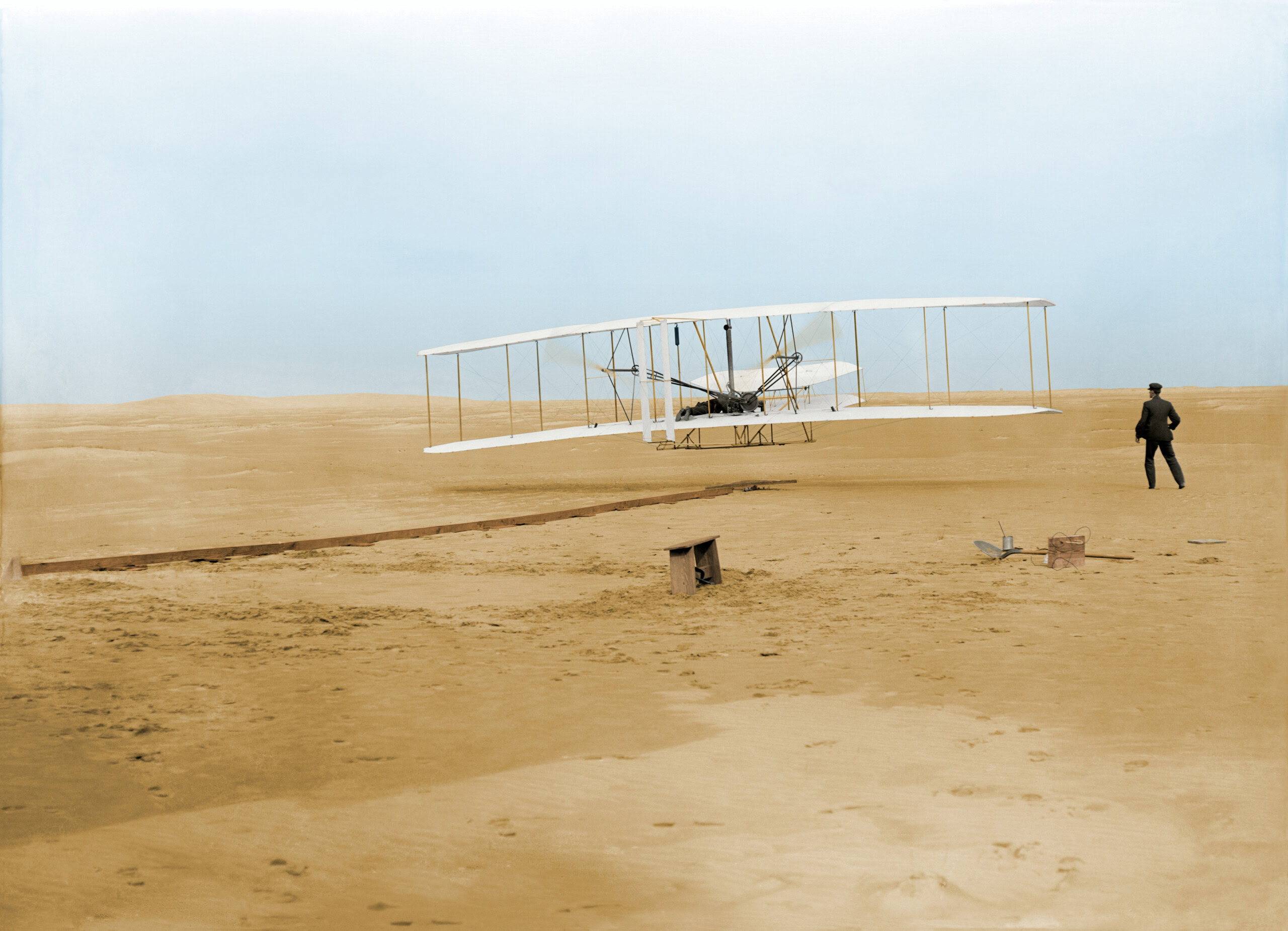
The Wright brothers, Wilbur (1867–1912) and Orville (1871–1948), were American engineers who achieved what many thought impossible – the first controlled, powered airplane flight. On December 17, 1903, Orville Wright piloted their wood-and-fabric biplane for 12 seconds over the dunes of Kitty Hawk, North Carolina, covering 120 feet in distance. In that moment, the Wrights inaugurated the age of human flight.
The brothers were bicycle makers by trade, which gave them practical engineering skills and a hands-on approach to problem-solving. They taught themselves aerodynamics through years of experiments with kites and gliders. Crucially, they invented three-axis control (using wing-warping, rudder, and elevator) to allow a pilot to steer an aircraft effectively. After many trials and errors, their Flyer finally stayed airborne in 1903.
Greatest Achievements
- Achieved the first sustained, controlled, powered heavier-than-air flight at Kitty Hawk on 17 December 1903
- Developed the crucial concept of three-axis control — roll, pitch, and yaw — which remains the basis of aircraft design today
- Built their own wind tunnel to generate aerodynamic data, pioneering a rigorous experimental methodology that continues to define aerospace engineering
Quotation
“Human flight is possible and practicable. It is only a question of knowledge and skill.” — Wilbur Wright
Ada Lovelace – The First Computer Programmer
In the 1840s – long before electronic computers existed – Ada Lovelace (1815–1852) envisioned how machines could calculate beyond mere arithmetic. Ada was a British mathematician who worked with inventor Charles Babbage on his proposed Analytical Engine (a mechanical general-purpose computer design). In 1843, while translating an article on Babbage’s machine, Lovelace added her own extensive notes that ended up far longer than the original paper. In these notes, she wrote out an algorithm for calculating Bernoulli numbers on the Analytical Engine – essentially the world’s first computer program. This is why Ada Lovelace is often called the first computer programmer.
In an era when women had little public role in science, Ada’s visionary insights went largely unacknowledged in her lifetime. Today, however, she is celebrated as a pioneer of computing science. The programming language “Ada” is named in her honour.
Lovelace features in our list of the most famous female engineers.
Greatest Achievements
- Wrote the first algorithm intended to be processed by a machine (Charles Babbage’s Analytical Engine) making her widely regarded as the world’s first computer programmer
- Recognised, decades before computers existed, that a calculating engine could go beyond pure arithmetic to manipulate symbols and compose music
- Her notes on Babbage’s engine (1843) were longer and more detailed than the original paper she was translating, and contained visionary insights into the nature of computation
Quotation
“The Analytical Engine has no pretensions whatever to originate anything. It can do whatever we know how to order it to perform.”

Engineering Summer Schools
Ready to begin your engineering journey?
Don’t miss the chance to sharpen your skills and fuel your inspiration – explore our Engineering Summer Schools and take your first step towards becoming one of the next generation’s great engineers.
The world of innovation is waiting for you!
Grace Hopper – The Queen of Code
Grace Hopper (1906–1992) was an American computer engineer and Rear Admiral in the U.S. Navy who fundamentally shaped modern programming. Often nicknamed “Amazing Grace,” she was a pioneer of computer programming languages. In the 1940s, computers had to be fed instructions in raw machine code (zeros and ones). Hopper envisioned that we could “talk” to computers using more human-friendly words. She developed the first compiler in 1952 (a program that translates written code into machine code), which led to the creation of COBOL – one of the earliest high-level programming languages.
COBOL allowed businesses and governments to write programs in English-like syntax, vastly expanding who could code and what computers could do. Hopper was also responsible for popularising the term “debugging” when she literally removed a moth stuck in a computer in 1947 (documenting the world’s first actual computer bug!).
Like Ada Lovelace, Hopper appears in our guide to the greatest women engineers in history.
Greatest Achievements
- Created the first compiler, opening programming to a far wider audience
- Led the team that developed COBOL, one of the most widely used programming languages in history, still running critical banking and government systems today
- Popularised the term “debugging”
Quotation
“Humans are allergic to change. They love to say, ‘We’ve always done it this way.’ I try to fight that. That’s why I have a clock on my wall that runs counter-clockwise.”
Sir Tim Berners-Lee – Inventor of the World Wide Web
In 1989, British software engineer Tim Berners-Lee changed the world by inventing the World Wide Web. At the time, he was working at CERN in Switzerland and noticed the difficulty scientists had in sharing information across different computers. Berners-Lee successfully communicated between a web client and a server using HTTP – effectively creating the first working web connection.
He designed and built the first web browser and editor, aptly named WorldWideWeb, and the world’s first web server. In August 1991, he made the web publicly available. Importantly, Tim gave the web away for free – an open invention for everyone to use, which allowed it to spread rapidly across the globe. Today, thanks to this invention, billions of people connect to websites and information instantly – an achievement that deservedly ranks him among the best engineers in the world.
Interested in computer science? Learn more about how to pick a career in computer science or explore our computer science summer school for an incredible, immersive experience of life in the industry.
Greatest Achievements
- Invented the World Wide Web, combining hypertext with the internet to create a system anyone could use
- Gave the Web away for free, ensuring it became a universal, open platform
- Founded the W3C (World Wide Web Consortium) to develop open web standards
Quotation
“The web is more a social creation than a technical one. I designed it for a social effect — to help people work together — and not as a technical toy.”
Dr. A.P.J. Abdul Kalam – India’s “Missile Man”
Avul Pakir Jainulabdeen Abdul Kalam (1931–2015), known as Dr. A.P.J. Abdul Kalam, was an Indian aerospace engineer who rose from modest beginnings to become a national hero. Kalam was the chief architect of India’s missile program in the 1980s, leading the development of the Agni and Prithvi missiles that gave India a self-reliant defence capability. His work on launch vehicles and guided missiles earned him the nickname “Missile Man of India” and means he deserves a place on our list of the best engineers in the world.
Earlier in his career, he was a key figure in India’s space research, helping develop the SLV-3, India’s first satellite launch vehicle, which successfully deployed a satellite in 1980. Despite his technical brilliance, Dr. Kalam was equally revered for his humility, inspirational speeches, and dedication to education – especially encouraging young people to pursue science and engineering. In 2002, Dr. Kalam became the 11th President of India, bringing his engineer’s mindset to the highest office of the country.
Greatest Achievements
- Served as chief project director of India’s first indigenous Satellite Launch Vehicle (SLV-3), which successfully deployed a satellite in 1980
- Led the development of India’s Agni and Prithvi ballistic missiles as head of the DRDO, earning the nickname “Missile Man of India”
- Served as India’s 11th President (2002–2007)
Quotation
“Dream, dream, dream. Dreams transform into thoughts, and thoughts result in action.”
Elon Musk – Engineering Entrepreneur of the 21st Century
Elon Musk (born 1971) is a South African-born engineer and entrepreneur known for tackling some of today’s biggest technological challenges. As the co-founder and CEO of SpaceX, Tesla, and other cutting-edge companies, Musk has pushed the boundaries of aerospace, automotive engineering, and clean energy.
In 2002, he founded SpaceX (Space Exploration Technologies Corp.) with the bold goal of making space travel cheaper and enabling the colonisation of Mars. In 2020, SpaceX’s Crew Dragon spacecraft carried astronauts to the International Space Station, the first private craft ever to do so. Meanwhile, Musk’s electric car company Tesla Motors has revolutionised the auto industry by proving that electric vehicles can be high-performing and desirable, spurring legacy carmakers worldwide to shift to electric cars.
In the 2020s, Musk has been increasingly involved in politics. He is known for his support for and subsequent feud with Donald Trump, and his ownership of X (formerly Twitter). Under his ownership, X has been accused of spreading misinformation and hate speech.
While often controversial, Elon Musk has undeniably demonstrated how an engineer’s vision, when paired with entrepreneurial drive, can bring transformative ideas into reality. Musk also featured on our list of the greatest entrepreneurs in history.
Greatest Achievements
- Founded SpaceX in 2002 and achieved the first successful recovery and reuse of an orbital rocket booster, dramatically reducing the cost of reaching space
- Led Tesla from a niche electric car startup to the world’s most valuable car company
- Developed the Falcon 9, Dragon spacecraft, and Starship
Quotation
“I don’t spend my time pontificating about high-concept things; I spend my time solving engineering and manufacturing problems.”
NASA’s Apollo 11 Team – Reaching the Moon Together
Not all engineering feats are the work of a single person – sometimes it takes a team of the best engineers in the world to achieve something truly historic. One shining example is the Apollo 11 mission in 1969, when humans first landed on the Moon. More than 400,000 engineers, scientists, and support staff collaborated on the Apollo program, solving countless technical challenges to make the Moon landing possible.
This team designed and built the gigantic Saturn V rocket (one of the most powerful rockets ever flown), the Apollo command and service modules that carried the astronauts, and the Lunar Module Eagle that landed on the Moon’s surface. They had to invent new materials, write novel software (the Apollo guidance computer had only 2KB of memory!), and calculate trajectories with incredible precision – all with 1960s technology. Their work culminated on July 20, 1969, when Neil Armstrong took “one giant leap for mankind.”
Greatest Achievements
Landed humans on the Moon on 20th July 1969
The lunar mission produced innovations in computing, materials science, and life support that shaped entire industries
Achieved a successful collaboration between 400,000 engineers, scientists, and technicians
Quotation
“I came in as a young pup. I was a fighter pilot—I did flight test. I was there in the very beginning. And all I can think of are the great people that I worked with that made all of this possible.” — Gene Kranz, Apollo Flight Director

Becoming the Next Great Engineer: Your Journey Starts Now
These stories – from Leonardo da Vinci to the Apollo 11 team – show that the title of the best engineers in the world isn’t limited by time, place, or background. The common threads are curiosity, creativity, and a determination to solve problems.
The best way to start is to learn by doing. To help you take your first steps, we’ve compiled a detailed guide on how to find engineering work experience.
If you’re ready for an unparalleled immersion into the profession, join us on one of our Engineering Summer Schools where you can get hands-on experience, learn from experts, and collaborate with other budding engineers.
FAQs
Although there is no official list of the best engineers in the world, there are some engineers who are commonly thought to be among the most innovative and influential. These include:
- Isambard Kingdom Brunel, known for Victorian civic engineering
- Nikola Tesla, known for pioneering work in electricity
- Grace Hopper, known for mid-20th century computer programming
- Tim Berners-Lee, known for inventing the world wide web
- Other engineers commonly considered the ‘best’ are Leonardo da Vinci and Ada Lovelace.
Traditionally, engineering was divided into four fields: civil, chemical, mechanical, and electrical. More recently, advances in technology have meant more fields have been added to this list, including aeronautical and computer engineering.
On our list of the ten best engineers in history, three come from the UK (Brunel, Lovelace, Berners-Lee) and five are from the US (the Wright Brothers, Hopper, the NASA Apollo 11 team, Musk, and Tesla (Musk and Tesla each gained US citizenship having been born in other countries)).
Today, the United States, Switzerland, Germany, Japan, South Korea, China and the UK are often seen as leading engineering nations because of their universities, research output, advanced industries and innovation ecosystems. For example, in the QS World University Rankings by Subject 2026 for Engineering and Technology, MIT and Stanford in the United States ranked first and second, while ETH Zurich in Switzerland ranked third. Switzerland, Sweden, the US, South Korea and Singapore also ranked among the top innovation economies in WIPO’s Global Innovation Index 2025.
The most famous engineers in history include the Wright Brothers, Isambard Kingdom Brunel, Tim Berners-Lee, and Nikola Tesla. Leonardo da Vinci is perhaps more famous than any of these, though his fame rests more on his achievements as an artist than his engineering – though his inventions and ideas did include some extraordinarily forward-thinking (if at times impractical) pieces of design.
Some of the greatest engineering innovations include electrification, the steam engine, clean water systems, railways, the automobile, the aeroplane, electronics, computers, the internet, medical imaging, satellites, antibiotics manufacturing, bridges, skyscrapers, and renewable energy technologies.
The US National Academy of Engineering selected electrification as the greatest engineering achievement of the 20th century, followed by the automobile, aeroplane, water supply and distribution, and electronics. Other achievements on its list included radio and television, agricultural mechanisation, computers, the telephone, air conditioning, spacecraft, the internet, health technologies, laser and fibre optics, and high-performance materials.
Sources
US Energy Information Administration